|
 
|
Ivory-Billed
Woodpecker
|
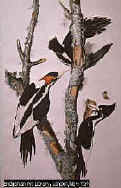
John James Audubon’s Ivory-billed Woodpecker is
from his work The Birds of North America (1827-1838). Audubon
depicted the birds clinging to trees, where they dig holes in the trunks
with their beaks in order to detect and extract insects. Their sharp-tipped,
straight beaks and extensile tongues are well-adapted for this purpose.
Bridgeman Art Library, London/New York
|
|
Downy
Woodpecker
|
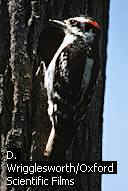
The downy woodpecker is one of the smallest woodpeckers in
the United States. Unlike its cousins, the downy woodpecker has a much
smaller bill and uses its stiff tail feathers to prop itself while probing
for insects.
D. Wrigglesworth/Oxford Scientific Films/Library of Natural
Sounds, Cornell Laboratory of Ornithology, Geoffrey A. Keller. All rights
reserved.
|
|
Common Flicker
|
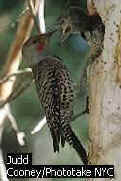
The yellow under the wings and tail, and the red crescent on
the nape of the neck, make the common flicker one of the most colourful
species of true woodpeckers. It ranges from Alaska to Newfoundland and south
throughout the United States east of the Rockies to Florida. The common
flicker usually inhabits lightly wooded areas but is also found in thickly
wooded and burned-out forest areas. It feeds mainly on ants, which it picks
up with its long, sticky tongue.
Judd Cooney/Phototake NYC/BBC Natural History Sound Library.
All rights reserved.
|
|
Yellow-Bellied
Sapsucker
|
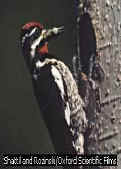
The yellow-bellied sapsucker, Sphyrapicus varius, a
member of the woodpecker family, is a migratory species found as far south
as Panama and as far north as southeastern Alaska or Newfoundland. It is
called a sapsucker because it drills small holes, or "wells," in
the sides of trees and then draws out sap with its long brush-tipped tongue.
Yellow-bellied sapsuckers also eat berries, as well as insects that are
attracted to the sap.
Shattil and Rozinski/Oxford Scientific Films/BBC Natural
History Sound Library. All rights reserved.
|
|
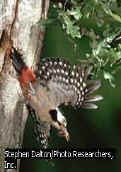
Syrian Woodpecker
|
The Syrian woodpecker (Dendrocopoc syriacus) is found
in southern Europe and occasionally central Europe. It lives in open
countryside with plenty of trees. It pecks at trees to excavate a hole that
acts as a nest, but also, through sound, to make contact with other birds of
the same species.
Stephen Dalton/Photo Researchers, Inc.
|
|
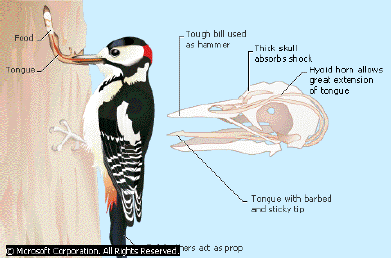
Woodpecker
Feeding
|
The woodpecker eats mainly insects, which it detects by
tapping the wood of trees with its bill. Whilst clinging to the trunk of the
tree, it excavates the insects with pickaxe-like strokes of its bill. It has
a sharp, straight, chisel-shaped bill and a long, extensile tongue with a
hard, spear-shaped tip which it uses to extract its food from within the
hole it has dug in the wood.
© Microsoft Corporation. All Rights Reserved.
|
[Animals and Bird] [Documentary]
[Home] |


