|
   
|
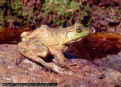
Bullfrog
|
The bullfrog, the largest frog native to the United States,
receives its name from its call, a deep thrum similar to the bellowing of a
bull, that it uses to attract a mate. It is highly predatory, feeding on
smaller frogs, worms, insects, and crustaceans, and since its introduction
to the British Isles, it has caused considerable damage to wildlife there.
Michael P.
Gadomski/Photo Researchers, Inc./Library of
Natural Sounds, Cornell Laboratory of Ornithology, Steven R. Pantle. All
rights reserved.
|
|
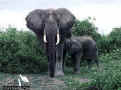
Social Structure of Elephant
|
Elephants are social animals and associate in small troupes
for protection from predators. Each elephant family unit is led by the
dominant female, or matriarch. When threatened, the members of the troupe
surround the calves to protect them from danger, the matriarch either
confronting the danger, or the group retreating in a tight unit.
Oxford Scientific Films/Hollywood Edge
|
|
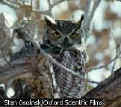
Great Horned Owl
Great Horned Owl
|
Nocturnal hunting requires no colourful plumage, so most
owls—both male and female—match the dull brown, daytime camouflage of
this great horned owl, Bubo virginianus. Smaller birds that spot a
resting owl may mob it, drawing attention to its concealed perch. Other
small animals are thus warned of the powerful talons and formidable 200 cm
(80 in) wingspan of the nearby owl. A great horned owl keeps its food supply
away from competitors (of both the same and different species) by defending
a territory.
Stan
Osolinski/Oxford Scientific Films/Library of Natural
Sounds, Cornell Laboratory of Ornithology. All rights reserved.
|
|
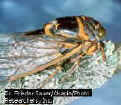
European Cicada
|
Suited to hot regions, cicadas are common around the
Mediterranean where the males "sing" from June until the end of
August to attract females. The "singing" is in fact buzzing or
shrilling sounds made with the help of two drum-like membranes (cymbals) on
the sides of the male’s abdomen.
Dr. Frieder
Sauer/Okapia/Photo Researchers, Inc.
|
|
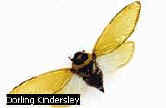
Cicada
|
The cicadas are related to the aphids and leafhoppers. The
cicadas have 13- and 17-year life cycles. All but about one month of a
cicada’s life is spent underground, where the larval stage, called a
nymph, feeds on sap from tree roots. All of the nymphs of a particular
species emerge from the ground at the same time, moult, feed, mate, and die.
Dorling Kindersley/BBC Natural History Sound Library. All
rights reserved.
|
|
Red Howler Monkey

|
This young red howler, Alouatta seniculus, has not
yet grown and may never get the long black beard its elders wear. A new male
that moves in to dominate a troop often kills young members already present.
Despite this seemingly counterproductive breeding strategy, the howler
monkey is one of the most widely distributed New World primates. It is
successful largely because of its ability to survive on nutrient- and
sugar-poor leaves, a diet more abundant than that of other species.
Aldo Brando Leon/Oxford Scientific Films/BBC Natural History
Sound Library. All rights reserved.
|
|
Mountain Zebra
|
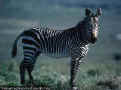
The mountain zebra is found in two mountainous areas of
southwestern Africa where there is abundant vegetation. All other zebra
species are found in more arid parts of Africa where vegetation is sparser.
The black-and-white striped pattern of the zebra provides disruptive
coloration (coloration that breaks up the body outline), making it difficult
for a predator to single out an individual zebra while it is running with
other animals in the herd.
Michael
Fogden/Oxford Scientific Films/Library of Natural
Sounds, Cornell Laboratory of Ornithology. All rights reserved.
|
|
Woodpecker
    
Downy
Woodpecker (Species Sporlight)
|
|
Laughing Kookaburra
|
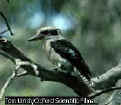
Its "laugh" is only one distictive feature of the
kookaburra, Dacelo novaeguineae. An anomaly in a family of fish
eaters, it prefers insects, small mammals, and reptiles. Its beak, however,
has the characteristic top-to-bottom flattening of other kingfishers.
Kookaburras also differ from most of their closest relatives in their mating
strategy. Adult offspring become helpers for a mating pair, assisting their
parents in feeding and defending the new broods.
Tom Ulrich/Oxford Scientific Films/Library of Natural
Sounds, Cornell Laboratory of Ornithology. All rights reserved.
|
|
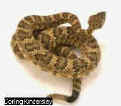
Rattlesnake
Rattlesnake
|
Rattlesnakes are members of the pit viper family. The pit
vipers range in length from about 38 cm (15 in) to about 1.5 m (5 ft). All
species in this family produce a venom with two distinct poisons. The first
contains a heart-lung depressant, the second a tissue-disintegrating agent.
Rattlesnakes are ovoviviparous—the young hatch from eggs inside the
female. Rattlesnakes have a rattle-like structure at the tip of their tail,
which is shaken when the snake is threatened or about to strike.
Dorling Kindersley/BBC Natural History Sound Library. All
rights reserved.
|
|
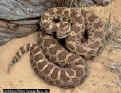
Massasauga Rattlesnake
|
The massasauga rattlesnake thrives in seasonally wet
prairies and forest edges from northern Mexico to south-eastern Canada. The
massasauga has become an endangered species because its habitat is
threatened by human activity.
Rod Planck/Photo Researchers, Inc.
|
|
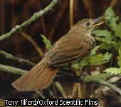
European Nightingale
|
The European nightingale is one of 340 species of thrushes
found throughout the world. The nightingale, like other thrushes, is
omnivorous, feeding on fruits, insects, and small invertebrates.
Tony
Tilford/Oxford Scientific Films/BBC Natural History
Sound Library. All rights reserved.
|
|
Dolphin Surfacing for Air

Bottlenose
Dolphins
Dolphin Research Institute,
Inc Dolphin - The Oracles
of the Sea Speeches by
Newton L. Gingrich |
As a dolphin swims, it breaks the surface of the water every
few minutes to breathe through a blowhole on the top of its head. Dolphins
inhabit all the world’s oceans, using their streamlined bodies to reach
underwater speeds of 40 km/hr (25 mph). This swimming ability, combined with
sharp teeth, enables dolphins to capture fish and squid, their principal
prey.
Stuart
Westmorland/ALLSTOCK, INC./Library of Natural Sounds,
Cornell Laboratory of Ornithology. All rights reserved.
|
[Documentary] [Home] |


