|
  
|
Christmas Cactus

|
The Christmas cacti are a group of bushy perennial cacti
growing to a height of about 15 cm (6 in). These cacti are often found in
shaded areas in rich, well-drained soils.
John
Kaprielian/Photo Researchers, Inc.
|
|
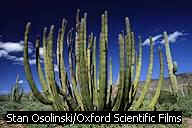
Organ Pipe Cactus
|
The organ pipe cactus grows in parts of Arizona, Baja
California, and northern Mexico at elevations below 1,000 m (3,000 ft). The
organ pipe reaches a height of 6.6 m (20 ft) and has white flowers and red
fruit.
Stan Osolinski/Oxford Scientific Films
|
|
Saguaro Cactus
|
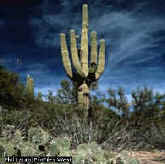
The saguaro cactus grows in parts of Arizona, eastern
California, and northern Mexico at elevations below 1,200 m (4,000 ft). One
of the largest of the cactus species, the saguaro reaches a height of 12.2
m (40 ft) and has spines up to 7.6 cm (3 in) long. Its white flowers
generally open only at night. The fruit is red.
Phil Lauro/ProFiles West
|
|
Prickly Pear Cactus
|
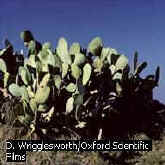
The prickly pear cactus is found throughout the
southwestern United States, Baja California, and the Sonoran Desert region
of Mexico. It is widely naturalized in many other areas, including Europe
and Australia. Prickly pears have whitish, yellow, orange, or red flowers
and greenish-brown, yellow, yellowish-green, red, or purple fruit, which
are suitable for human consumption. The cactus plants themselves are also
edible and are commonly used for livestock feed.
D. Wrigglesworth/Oxford Scientific Films
|
|
Jumping Collar Cactus
|
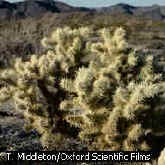
The jumping cholla, native to rocky deserts and hillsides
of Baja California, northern Mexico, Arizona, and New Mexico, grows to a
height of 5 m (15 ft). The plant has lavender flowers and a greenish fruit
that grows in a chain-like fashion over a period of years.
T. Middleton/Oxford Scientific Films
|
|
Saguaro Forest
|
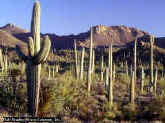
Saguaro National Park in Arizona includes forests of
saguaro cacti or giant desert cacti. The saguaro cactus can live to be 200
years old, reach heights of around 15 m (50 ft) , and weigh as much as 9
metric tonnes. It grows extremely slowly, however, and after 50 years it
may only be 2.1 m (7 ft) tall.
Matt Bradley/Bruce Coleman, Inc.
|
|
Cactus and Spurge Plants
|
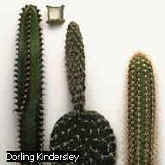
Although all three of the plants in this picture appear to
be cactus plants, the one to the far left is a spurge, not a true cactus.
While both the cactus and the spurge have reduced, spiny leaves to prevent
water loss, and a large, succulent stem for water storage, they are quite
different plants, distinguished by the presence of a milky latex-like fluid
in the stem of the spurge. This similar adaptation to their arid
environment is an example of convergent evolution.
Dorling Kindersley
|
|
Barrel Cactus
|
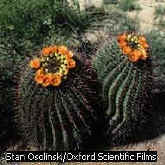
Various species of barrel cactus in the genus Ferocactus
grow in parts of Baja California, Mexico, Arizona, and California at
elevations below 2,000 m (6,000 ft). Depending on the species, barrel
cactus plants reach a maximum size of 1.5 to 3 m (5 to 10 ft). The flowers
are generally a yellow, greenish-yellow, purplish-red, or orange colour.
Stan Osolinski/Oxford Scientific Films
|
|
Web Links
The Cactus & Succulent Plant Mall
The Cactus and Succulent
Plant Mall
|
[Endangered Species] [Documentary]
[Home] |


