   
| Aye-Aye
|
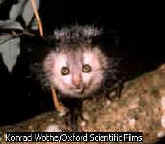
The aye-aye belongs to a group of arboreal mammals known as
lemurs. This solitary, nocturnal mammal has very large incisors, toes, and
fingers. The aye-aye, which is found only in the coastal rain forests of
Madagascar, feeds primarily on insect larvae and fruits.
Konrad Wothe/Oxford Scientific Films
|
|
Dugong

Dugong
Introduction
to the Sirenia
Manatee
Junction
|
This male dugong is among only a few thousand of the large
marine mammals believed to remain in the Indian and western Pacific oceans.
Dugongs, commonly called sea cows, have long been hunted for their meat,
blubber, oil, and hide. The harmless animal uses its rounded forelimbs for
locomotion and its muscular lips to crop water plants for food.
Fred McConnaughey/Photo Researchers, Inc.
|
|
Cheetah
The Cheetah Spot
|
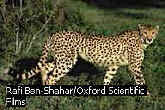
Because of extensive inbreeding, the cheetah has one of the
lowest degrees of genetic diversity among mammals. Genetic variation
between cheetahs is so low that a given animal does not recognize the
difference when a tissue graft from another cheetah surgically replaces its
own tissue. These low levels of diversity make the cheetah species
extremely vulnerable to disease and threaten its ultimate survival.
Scientists hope to use modern captive breeding programmes to increase
genetic diversity in the species.
Rafi Ben-Shahar/Oxford Scientific Films
|
|
Giant Panda Bear
Giant Panda Bears
|
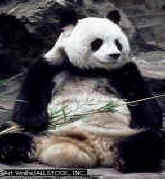
An enlarged wrist bone provides the bear-like giant panda, Ailuropoda
melanoleuca, with a second "thumb" to grip the bamboo shoots
that are the mainstay of its diet. This animal, discovered as recently as
1839, exists naturally only in the cool mountain forests of the Sichuan
(Szechwan), Shaanxi (Shensi), and Gansu (Kansu) provinces of China. There
are very few still living in the wild, and efforts at captive breeding have
been largely unsuccessful.
Art Wolfe/ALLSTOCK, INC./BBC Natural History Sound Library.
All rights reserved.
|
|
Whooping Crane
The Majestic & Endangered
Whooping Crane :An Alberta, Canada Perspective |
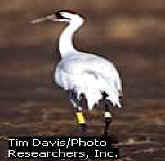
The whooping crane, Grus americana, has long been
considered one of the most endangered species of bird in the United States.
Although only 14 of these birds existed in 1941, current estimates put the
population at more than 200 individuals.
Tim Davis/Photo Researchers, Inc./Library of Natural
Sounds, Cornell Laboratory of Ornithology. All rights reserved.
|
|
Giant Tortoise
|
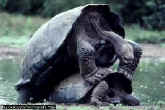
The giant tortoise, Geochelone elephantopus, is
found on the Galápagos Islands. This slow-moving reptile is the largest
species of tortoise in the world and lives to be well over 100 years old.
All tortoises lay eggs. The destruction of nesting sites worldwide has
caused many species, including the giant tortoise, to become endangered.
Tui De Roy/Oxford Scientific Films
|
|
Orang-Utan
Great
Ape House
Orangutan Foundation
International
Species
Data Sheet: Orangutan |
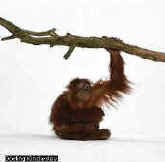
The orang-utan, Pongo pygmaeus, whose name derives
from the Malay words for "old man of the forest", has a high,
arched forehead that gives it a distinctly human visage. Long red hair
distinguishes it from other apes, as does its habit of foraging for food
individually, rather than in groups. Orang-utans have been observed to eat
more than 200 kinds of fruit. They live almost exclusively in the trees and
are quite awkward on the ground, where they move slowly on all fours. This
ape is found only in lowland and tropical rainforest areas of northern
Sumatra and lowland Borneo.
Dorling Kindersley/BBC Natural History Sound Library. All
rights reserved.
|
|
Blue Whale
Blue Whale |
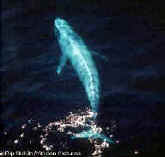
The blue whale, the largest animal ever to exist, may grow
to 29 m (95 ft) in length. The loud moans of blue whales may carry through
deep waters more than 160 km (100 mi) away, allowing them to communicate
across vast distances. Hunted nearly to extinction in the first half of the
20th century, blue whales are now protected, although they remain
endangered.
Flip Nicklin/Minden Pictures
|
|
Cactus
     
 
The Cactus & Succulent Plant
Mall |
|
Indian Elephant
|
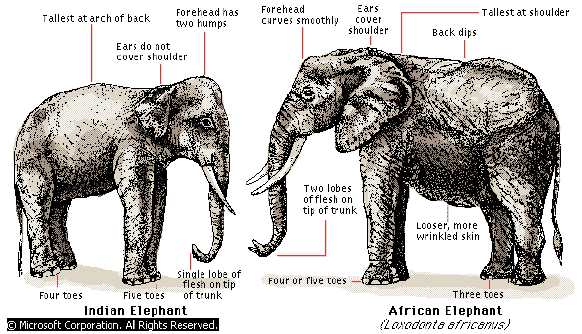
The two extant species of the family Elephantidae can be
distinguished easily by the size of their ears—small in the Indian and
quite large in the more massive African. A closer look reveals several
other differences. The prehensile trunk of the Indian elephant, for
example, has only one lobe at the end, whereas that of the African has two.
Both of the animals illustrated here are male: not visible is the absence
of long tusks in the female Indian elephant.
© Microsoft Corporation. All Rights Reserved.
|
|


