|
  
|
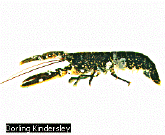
European Lobster
|
Besides helping to provide locomotion, protection, and
support, the asymmetrically shaped claws of the European lobster manipulate
food. Sometimes the lobster attaches other smaller marine animals, such as
tube-building worms and barnacles, to its hard outer shell, or exoskeleton.
Dorling Kindersley
|
|
Spiny Lobster
|
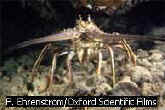
The spiny lobster, seen sitting at the entrance of a shallow
cave, has a smaller body than its cousin, the true or Maine lobster, and
lacks the enormous pincers at the ends of the chelipeds, or first pair of
legs. The spiny lobster makes a remarkable annual migration, in which large
numbers of individuals move in single file across the deep-sea floor.
Although the purpose of the migration is poorly understood, it is thought to
be involved with reproduction.
F. Ehrenstrom/Oxford Scientific Films
|
|
Rock lobster
|
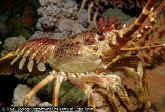
Rock or spiny lobsters, sometimes referred to simply as
lobsters, lack the enlarged claws of true lobsters. Commercial catches
originate largely in the waters off South Africa, Australia, New Zealand,
France, Japan, Brazil, Cuba, the United States, Mexico, and the Bahamas. The
most important of the commercial lobsters fished off South Africa is the rock
lobster Jasus ialandii, shown here. They prefer reefs for shelter, and
are found at depths ranging from 5 to 275m (15 to 850 ft).
B. Riegl, Zoology Department/University of Cape Town
|
|
Lobster Exoskeleton Dismantle
|
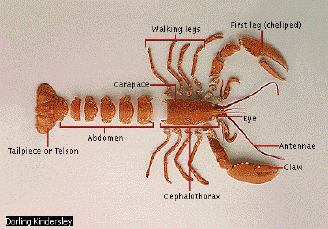
The exoskeleton of a lobster is divided into a series of
segments each of which performs specialized functions. The cephalothorax,
consisting of the head and thorax, bears all the limbs used in sensory
perception, locomotion, breathing, and the detection and capture of prey. The
abdomen is divided into six segments that are responsible for rapid
locomotion.
Dorling Kindersley
|
[ Intrepid and
Travelers] [Documentary] [Home] |


