|
Monarch
Butterfly
  
Migration
Monarch
Butterflies
|
|
Arctic Tern
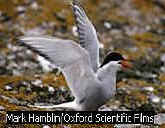
Arctic Tern
Gateway to Antarctica
Gateway to Antarctica-Antarctic
Treaty System Ozone
Depletion Over Antarctica
|
The Arctic tern has the most remarkable migration pattern
known for any animal. Each year the Arctic tern migrates from nesting
grounds in the Arctic south to the Antarctic and back, a round trip of
nearly 40,000 km (25,000 mi). Nesting occurs in the autumn on Arctic beaches
or in areas of tundra.
Mark Hamblin/Oxford Scientific Films/BBC Natural History
Sound Library. All rights reserved.
|
|
Least Tern
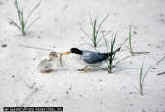
One Small Tern Deserves
Another-Least Tern
|
At 20 cm (8 in) long, the least tern is the smallest of the
tern species. It dwells on coastal beaches and builds nests by making
depressions in the sand. It relies on camouflage to protect its eggs and
young.
Dan Guravich/Photo Researchers, Inc.
|
|
Barren Ground Caribou
|
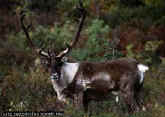
Deer antlers are completely different from the hollow,
permanent horns of other ruminants. Antlers are shed and regenerated
annually, their growth controlled by sex hormones. In the spring, antlers
have a velvet appearance due to the thin coat of fine hairs that supplies
them with nourishing blood flow. Within a few months, antler growth is
complete and blood circulation in the velvet ceases. The deer rubs its
antlers against a tree to scrape away the dead skin. The caribou, Rangifer
tarandus, is the only deer species in which females grow antlers.
Lon E. Lauber/Oxford Scientific Films
|
|
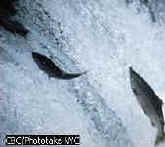
Sockeye Salmon Navigating Falls
|
Salmon begin their life in small, freshwater streams, where
they hatch from eggs buried in gravel nests built by their parents. Following
a brief residence in freshwater, the salmon swim to the sea where they mature
into adults. At four to five years of age, the adults return to their home
streams, completing the cycle. Sockeye salmon navigate falls, rapids,
commercial fishing nets, and other obstacles during their return to spawn.
CBC/Phototake NYC
|
|
Coho Salmon
|
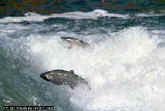
Once one of the most common species of salmon in the Pacific
Northwest, the Coho have been diminished to 5 to 10 per cent of their former
population by a combination of overfishing, habitat destruction, and the
erection of a series of dams.
THE BETTMANN ARCHIVE/Corbis
|
|
Barn Swallow
Barn Swallow
|
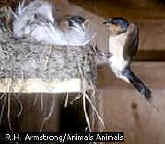
Barn swallows are the most abundant species of the birds
known as swallows, which have come to symbolize good luck and the coming of
spring. Barn swallows use mud to construct open nests often in or on
buildings, bridges, jetties, and other structures. Both the male and female
share the task of carrying more than 1,000 mouthfuls of mud to the nest, then
the female finishes the job by lining the inside of the new home with
feathers and grass.
R.H. Armstrong/Animals Animals/Library of Natural Sounds,
Cornell Laboratory of Ornithology. All rights reserved.
|
|
Sperm Whale
SPERM WHALE
|
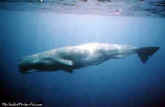
Sperm whales, found in most oceans, derive their name from
the oily fat—called spermaceti—contained in their large heads.
Diving deep in search of squid, sperm whales may remain submerged for as long
as an hour.
Flip Nicklin/Minden Pictures
|
|
Broken-Striped Newt
|
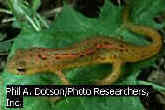
The adult broken-striped newt is found in ponds, pools, and
quiet streams in low-lying coastal areas of North and South Carolina. Growing
to a maximum size of 9.5 cm (3.75 in), this newt feeds on insects, leeches,
small amphibians, worms, small crustaceans, and frogs’ eggs.
Phil A. Dotson/Photo Researchers, Inc.
|
|
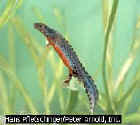
Alpine Newt
|
This male alpine newt (Triturus alpestris) is found
over much of central Europe, southwards to the Balkan peninsula, and east to
the Ukraine. It grows to a length of 7-11 cm (3-4 in). Females of the species
are larger than the males.
Hans Pfletschinger/Peter Arnold, Inc.
|
|
Elephant
   
Discovering
Laos: The land of a Million Elephants
Elephant Man, The (1980)
Introduction
to the Proboscidea
The Elephant of the
Africa
The Elephant of the Cameroon
Tusk, Tusk:
Lifting the ban on ivory
Wuchereria Bancroft: The causative agent of Bancroftian Filariasis
|
|
Lobster
   
|
|
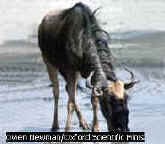
Blue-Wildebeest, Ngorongoro Crater,
Tanzania
|
The blue wildebeest, or brindled gnu, Connochaetes
taurinus, is native to the open woodlands and grasslands of southern
Africa and is one of its fastest residents. Standing about 137 cm (54 in)
tall, brindled gnus are larger than the related black wildebeest (also called
the white-tailed gnu), whose range is limited to Africa.
Owen Newman/Oxford Scientific Films
|
|
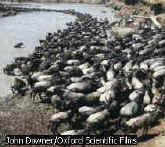
Migrating Wildebeest
|
The blue wildebeest migrates annually from Kenya to northern
South Africa. Along their migratory route the wildebeest stop at watering
holes on the River Grameti, where they become the chief source of food for
Nile crocodiles. Scientists speculate that the crocodiles of the River
Grameti may feed only once a year, when blue wildebeest arrive during their
annual migration.
John Downer/Oxford Scientific Films
|
|
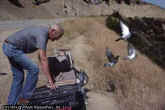
Homing Pigeons
|
The homing pigeon, a domesticated species of the rock pigeon,
is trained to return to its home roost, or loft. Homing pigeons are thought
to use navigation cues like the earth’s magnetic field, local topography,
the sun’s position, and ultraviolet light patterns in the sky. In addition
to their value in transporting messages, homing pigeons are used in research
on bird migration.
Tom McHugh/Photo Researchers, Inc./Library of Natural Sounds,
Cornell Laboratory of Ornithology. All rights reserved.
|