|
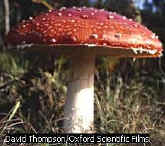
Fly Agaric
|
The brightly coloured fly agaric is one of several poisonous
mushrooms containing ibotenic acid and a number of other organic poisons. If
eaten, the fly agaric can cause hallucinations and result in coma. It was
formerly mixed with milk and used as a primitive fly paper.
David Thompson/Oxford Scientific Films
|
|
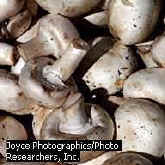
Edible Mushroom
|
The edible commercial mushroom is cultivated in buildings or
caves in which temperature and humidity are strictly regulated. A special
bedding culture is prepared and inoculated with a pure culture of the fungus
mycelium. Several crops of mushrooms are produced from each inoculation.
Joyce Photographics/Photo Researchers, Inc.
|
|
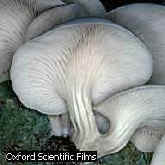
Oyster Fungus
|
The oyster fungus is an edible mushroom of the family
Agaricaceae. It has a distinctive oyster-like flavour when cooked. The
oyster mushroom can be found growing on decaying logs and stumps from June
until November.
Oxford Scientific Films
|
|
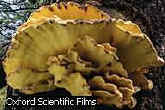
Chicken of
The Woods
|
The chicken of the woods is one of the edible mushrooms.
Although this species grows to several metres in width, it is edible only
when young. When old the normally edible portion becomes quite tough and
infested with insect larvae.
Oxford Scientific Films
|
|
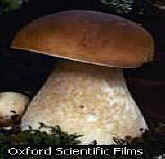
Cep Mushroom
|
The cep mushroom, or penny bun, is typically found in open
deciduous forests during the summer and early autumn months. Many other
related mushroom species are also edible.
Oxford Scientific Films
|
|
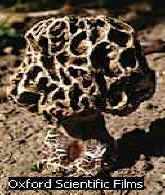
Morel
|
The morel is easily distinguished from nearly all other
mushrooms by its irregular honeycombed appearance and excellent flavour.
Morels are found during the spring months in old orchards and especially in
areas that have been burned.
Oxford Scientific Films
|
|
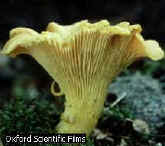
Chanterelle
|
The chanterelle is one of the most popular edible mushrooms.
Harvested since Roman times throughout Europe, it is prized for its nutty
flavour. Unlike some species of edible fungus, larger specimens of
chanterelles provide a better texture and flavour than do smaller ones.
Oxford Scientific Films
|