|
Penguin Character
|
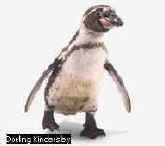
The 16 species of penguins found in the southern hemisphere
are all flightless birds adapted to an aquatic existence. Penguins are
insulated from cold seawater by three layers of short, dense feathers and a
subcutaneous layer of fat. The wings are modified into stiff flippers for
rapid swimming under water, while the webbed feet are used together with the
tail as rudders for turning.
Dorling Kindersley/Library of Natural Sounds, Cornell
Laboratory of Ornithology. All rights reserved.
|
|
King Penguins
|
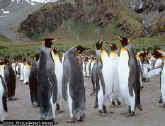
A colony of king penguins gathers on South Georgia, an
island near the southern tip of South America. King penguins may stand about
1 m (3 ft) tall, making them the second-largest penguin species.
Johnny Johnson/Animals Animals
|
|
Little Blue
Penguin
|
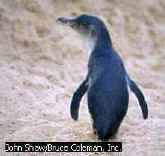
This penguin’s brilliant blue coat stands out against the
dull colours of the surrounding rock, but provides excellent camouflage in
the water. The smallest of 18 penguin species at 41 cm (16 in) long, the
little blue penguin makes its home on the southern coasts of Australia and
New Zealand.
John Shaw/Bruce Coleman, Inc.
|
|
Penguin Rookery
|
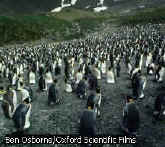
Penguin rookeries are breeding areas where large numbers of
penguins gather to mate, breed, and raise their young. The largest penguin
rookeries, where hundreds of thousands to millions of penguins may gather,
are located along the coast of Antarctica and on several Antarctic islands.
Penguins always return to the rookery where they were born.
Ben Osborne/Oxford Scientific Films
|
|
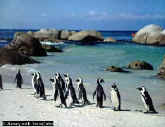
Jackass
Penguins on Boulders Beach, South Africa
|
Boulders Beach provides a sheltered nesting place for a
colony of Jackass penguins. The beach lies within the sweep of False Bay on
the eastern side of the Cape Peninsula, close to plentiful supplies of fish,
but away from the pounding waves of the Atlantic Ocean. Mainland colonies are
rare, and although the numbers of Jackass penguins are declining overall, the
penguin colony at Boulders has increased in size in recent years.
O. Alamany and E. Vicens/Corbis
|
|
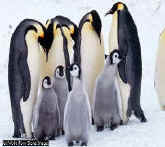
Emperor
Penguins Guarding the Chick
|
Adult emperor penguins stand guard over a group of chicks,
who are covered with down (short, fluffy feathers) until they reach
maturity. In general both parents share responsibility for their offspring.
Art Wolfe/Tony Stone Images
|
|
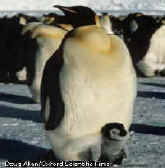
Penguin
Keeping Its Young Warm
|
Penguins always return to their ancestral nesting sites to
lay their eggs and rear their young. The emperor penguin, the largest of the
penguins, lays its single egg during the coldest time of the year, when
temperatures drop as low as -66° C (-80° F). The egg is incubated on top of
the parent’s feet, protected by abdominal folds of skin. Young chicks
remain under these abdominal folds for a short time until they are able to
regulate their own body temperature.
Doug
Allan/Oxford Scientific Films
|