|
Dromedary
Bactrian
Camels
Bamburgh
Castle
Camelopardalis
Dr.
Robinson on Camel
The
International Camellia Society (ICS)
The
Junior Ganymede Club Book
The Tower of
London
Woburn
Abbey
|
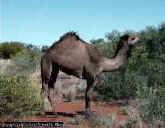
A series of impressive water conservation adaptations makes
it possible for some camels, Camelus dromedarius, to go for a long
time without drinking. Body temperature, for example, can rise by 6 to 8° C
(11 to 14.5° F) to minimize sweating. Pouches in the stomach store water,
releasing it as the camel needs it. A thirsty camel can consume as much as
120 litres (25 gallons) of water to replenish its reserves.
David Curl/Oxford Scientific Films/Library of Natural
Sounds, Cornell Laboratory of Ornithology. All rights reserved.
|
|
Penguin

     
Penguin Classics
Talking
Heads
The Penguin
Page
|
|
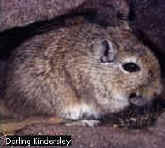
Mongolian Gerbil
|
Because gerbils have proportionally more surface area than
volume, water evaporates from their bodies very quickly. They cannot stay
outside for more than a few hours of daylight in their warm, arid habitats
or they suffer from dehydration. Instead, most gerbils are active at night,
collecting dry seeds when they are soaked with dew. Adaptations such as a
large middle ear, capable of detecting low-frequency sound like the flapping
of an owl’s wings, help protect gerbils from nocturnal predators. The
Mongolian gerbil is Meriones unguiculatus.
Dorling Kindersley
|
|
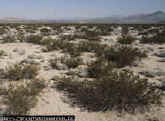
Creosote Bush
|
The creosote bush is native to arid regions of the
southwestern United States and South America. These plants exhibit an
interesting type of growth in which the crown of an individual plant splits
into large lobes, each of which then bends back into the soil and develops
its own roots and branches. One particular cluster in the Mojave Desert is
estimated to be approximately 11,700 years old.
Jerry L. Ferrara/Photo Researchers, Inc.
|
|
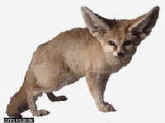
Dessert-dwelling Fennec Fox
|
The desert-dwelling fennec has the largest ears of any fox,
in proportion to its body size. It uses its ears to cool itself and to detect
the sounds of predators and prey.
Dorling Kindersley
|
|
Gila Monster
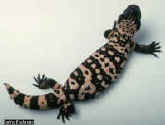
Gila Monster
|
The Gila monster, one of only two venomous lizards in the
world, is found in desert regions of Arizona, Nevada, Utah, and New Mexico.
The venom glands are located in the lower jaw, and venom is injected through
the teeth of the lower jaw in such a manner that the Gila monster must chew
in order to poison its prey.
Dorling Kindersley
|
|
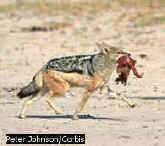
Black-Backed Jackal Scavenging
|
A black-backed jackal (Canis mesomelas) flees with a
piece of scavenged meat, in Hwange National Park, Zimbabwe. Although jackals
do hunt small prey, they also scavenge from the kills of larger predators,
either stealing morsels when they can, or waiting to feed once the predator
has left.
Peter
Johnson/Corbis
|
|
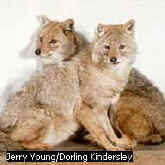
Jackal
|
Jackals form remarkably long-lasting pair bonds. Males
enforce this monogamy by chasing off any suitors whose presence threatens the
survival of their progeny. A jackal pair raises a litter together but may be
away from their den as much as 40 per cent of the time obtaining food, which
they regurgitate for the young. A pup from a previous litter may remain with
the family as a helper and protector. Pictured here is the golden jackal, Canis
aureus.
Jerry Young/Dorling Kindersley
|
|
Succulent

The Cactus and Succulent Plant Mall
|
The thick fleshy leaves or stems of succulent plants, native
to marshes and semidesert conditions, swell in damp conditions to store as
much fresh water as possible. Adaptations such as the white coloration and
waxy, water-sealing coating of some succulents reduce evaporation. The plants
wrinkle as water is used up.
Dorling Kindersley
|
|
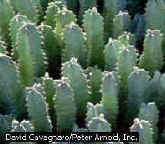
Spurge
|
Spurges, and many other succulents, have a confusing
similarity to cacti, with thick succulent stems and leaves reduced to spines.
It is an example of convergent evolution, in which two separate groups of
species develop similar adaptations to similar, but geographically distant
environments. Whereas cacti complete their development in the arid parts of
America, the root-succulent succulents originate mainly from the tropical,
arid areas of the African continent.
David
Cavagnaro/Peter Arnold, Inc.
|
|
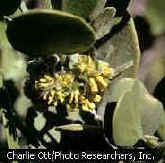
Jojoba Plant
|
The jojoba plant, native to the Sonoran Desert of the United
States and Mexico, is grown commercially throughout the world for its seeds,
which yield a high-grade oil. Jojoba oil is used in the manufacture of
cooking oil, shampoo, and lubricants, as well as in other cosmetic and
industrial applications.
Charlie Ott/Photo Researchers, Inc.
|
|
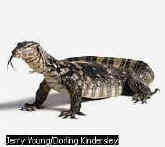
Monitor (Lizard)
Dragon
Doing
|
The monitor, known in Australia as the goanna, is the largest
of the living lizards. Possessing a long, forked tongue and powerful jaws
that can unhinge in order to swallow large prey, the monitor eats a wide
variety of foods, including carrion, birds, insects, reptiles, snakes, and
eggs. The monitor is primarily terrestrial, although it does have the ability
to swim and climb trees.
Jerry Young/Dorling Kindersley
|