   
|
Leopard
Gottopardo, Il (1963)
Snow
Leopard (Species Data Sheet) |
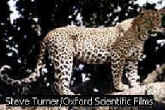
To the leopard, Panthera pardus, trees serve as
resting place, hunting ground, and place for storing food. High above the
ground, leopards can ambush terrestrial prey and, dragging it back up
behind them, keep it out of scavengers’ reach. Leopards hunt alone and at
night, focusing on smaller animals that are less desirable to competitive
predators such as lions, hyenas, and tigers.
Steve Turner/Oxford Scientific Films/Library of Natural
Sounds, Cornell Laboratory of Ornithology. All rights reserved.
|
|
Humpback Whale
Humpback
and Northern Right Whales
Virtual
Whales |
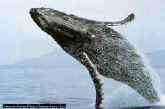
Here seen off the Abrolhos Archipelago, Brazil, this 15 m
(50 ft) humpback whale is a magnificent sight as it leaps entirely free of
the water before falling back down in a cascade of foam. It is an activity
that can be witnessed throughout the year.
|
|
Tiger
Cardiff Castle
Carnivore Preservation Trust
Sabretooth
Cats
The Salt Creek
Tiger Beetle
The Tiger Information Center
The Beetle World |
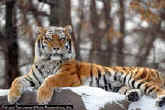
The Siberian tiger has been hunted to near extinction in
many Asian countries, where its body parts are sold for medicinal purposes
and for cooking.
Pat and Tom Leeson/Photo Researchers, Inc.
|
|
Condor
Andean
Condor
California
Condor
Condorcet
|
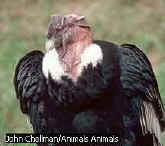
With a wingspan of up to 3.25 m (about 10 y
ft), the Andean condor is one of the largest flying birds in the world. It
is found in the Andes from Venezuela to Cape Horn and feeds almost
exclusively on carrion, or rotting flesh.
John Chellman/Animals Animals
|
|
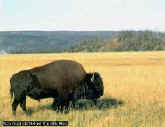
Plains Bison
|
Originating in Eurasia but migrating to North America
across the Bering land bridge during prehistoric times, the American bison
thrived on the Great Plains, until the arrival of white settlers drove them
to the brink of extinction. Although they once ranged across the Great
Plains from Mexico to Canada, with numbers estimated at 60 million, today
they exist primarily on game reserves and ranches, with estimated numbers
of only 30,000.
Stan Osolinski/Oxford Scientific Films/Library of Natural
Sounds, Cornell Laboratory of Ornithology. All rights reserved.
|
|
Gorilla
Gorillas
Great
Ape House
Mountain Gorilla
The Dian Fossey Gorilla Fund
The Gorilla Foundation
Your
Life As a Gorilla |
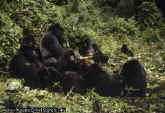
A gorilla group centres around its silverback male, seen at
the upper left of this gathering. Because females leave their birth groups
to join a male, they are rarely related to each other, eliminating the tie
that is usually the strongest in a primate colony. It is instead the
dominant male’s relationship with each member of his group that holds it
together. During rest and play periods, females with young tend to stay
closest to the silverback. In this way, their infants quickly get used to
his protective yet imposing presence.
Andrew Plumptre/Oxford Scientific Films/BBC Natural History
Sound Library. All rights reserved.
|
|
Rhinoceros
International Rhino Foundation
Rhinoceros
Auklet |
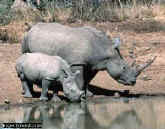
A female white rhinoceros keeps a wary eye open while she
and her calf drink at a water hole in South Africa. About 90 per cent of
white rhinoceroses are found in South Africa, where their numbers are
gradually beginning to increase again after dwindling dramatically over the
last 30 years.
Roger Tidman/Corbis
|
|
Snow Leopard

Snow Leopard
(Species Data Sheet) |
The snow leopard, Uncia uncia, is found only in
coniferous forest scrub and mountain steppe regions of the Himalayas and
surrounding areas. Generally solitary in habit except during mating season,
the snow leopard may be found at 6,000 m (19,000 ft) and higher in search
of migratory game such as wild sheep, ibex, and musk deer. It is considered
an endangered species.
Tim Davis/Photo Researchers, Inc.
|
|
Dodo
|
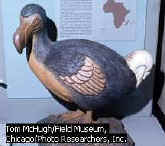
The dodo, a large flightless bird that lived only on the
island of Mauritius, was originally described in 1598. It had become
extinct less than 100 years later as a result of the adverse impact of
European settlers and their domestic animals.
Tom McHugh/Field Museum, Chicago/Photo Researchers, Inc.
|
[Documentary] [Home] |


