|
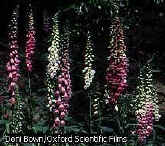
Common Foxglove
|
The common foxglove is grown for decorative and medicinal
purposes. The flowers contain glycosides, chemicals that can be used to
regulate and improve heartbeat. If plant materials containing glycosides are
directly eaten by human beings, nausea, abdominal pain, diarrhoea, and
heartbeat and pulse abnormalities can result. If large enough quantities are
consumed, convulsions and death can ensue.
Deni Bown/Oxford Scientific Films
|
|
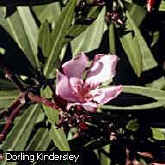
Oleander
|
The oleander, a bushy evergreen shrub native to southern
Europe, is also widely planted in warm regions as a decorative shrub.
Dorling Kindersley
|
|
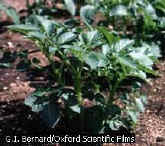
Potato Plant
|
Native to the Andes of Peru, the potato plant is now
cultivated throughout the temperate regions of the world. It is grown for
human consumption and for its starch, which is used in the manufacture of
alcohol and adhesives.
G.I. Bernard/Oxford Scientific Films
|
|
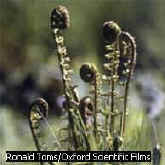
Bracken Fiddleheads
|
The "fiddleheads" on a bracken plant are the
young, unrolling fronds. Bracken, or brake, is a common fern found in many
parts of the world. It produces two poisonous chemicals that destroy
thiamine (vitamin B 1)
and cause widespread haemorrhaging and bone marrow destruction.
Ronald Toms/Oxford Scientific Films
|
|
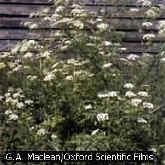
Poison Hemlock
|
The name "poison hemlock" refers to two entirely
different poisonous herbs (Conium, pictured here, and Cicuta)
that, if eaten, can cause convulsions, respiratory arrest, damage to the
central nervous system, and death. Native to Europe and the United States,
these plants range in size from 5 cm to 3 m (2 in to 10 ft).
G.A. Maclean/Oxford Scientific Films
|
|
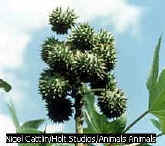
Fruit of The Castor-Oil Plant
|
The spiny fruit of Ricinus communis, which is also
known as the castor-oil plant, contains the beans from which the traditional
purgative, castor oil, is pressed. With further processing, castor beans
yield a type of oil suited for use in paints, varnishes, and dyes. In their
natural state, however, the seeds, along with all other parts of the plant,
are highly poisonous.
Nigel Cattlin/Holt Studios/Animals Animals
|
|
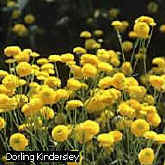
Meadow Buttercup
|
Although buttercups such as Ranunculus acris,
pictured here, abound in pastures, grazing cows avoid them; ingesting the
foliage irritates the mucous membranes of the digestive tract. However,
dried buttercups are harmless inclusions in hay.
Dorling Kindersley
|
|
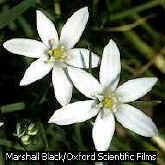
Star-of-Bethlehem
|
The star-of-Bethlehem is widely cultivated for its white,
star-shaped flowers. The herb contains poisons in its bulb that can cause
death if eaten.
Marshall Black/Oxford Scientific Films
|
|
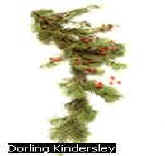
Yew
|
The yew tree is cultivated as an ornamental plant. The bark
of the Pacific yew has certain chemical derivatives that show promise in the
treatment of ovarian cancer.
Dorling Kindersley
|
|
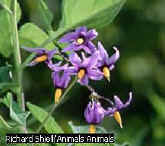
Spindle
|
Spindle or woody nightshade (Solanum dulcamara) is a
climbing plant that belongs to the Solanaceae family. It is commonly found
in damp areas on the edges of woods and in hedges in Europe. The typical
Solanaceae flower consists of five folded-back petals from which the yellow,
stunted conical stamens project.
Richard Shiell/Animals Animals
|
|
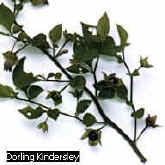
Nightshade
|
All parts of the deadly nightshade, or belladonna, Atropa
belladonna, are poisonous. The drug atropine, used to dilate the pupils
of the eyes, is one of several narcotics extracted from its leaves and
roots.
Dorling Kindersley
|