|
   
|
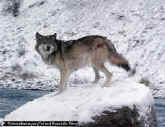
Grey Wolf
|
The grey wolf is one of approximately 35 species belonging
to the family Canidae, which includes the coyote, jackal, fox, and dog. This
family is believed to have originated in North America 56.5 to 35.4 million
years ago during the Eocene Epoch. The grey wolf, also called the timber
wolf or white wolf, is distributed across northern Europe, Asia, and North
America. It is found in a variety of habitats including mountains, plains,
deserts, forests, tundra, and taiga.
F. Schneidermeyer/Oxford Scientific Films/BBC Natural
History Sound Library. All rights reserved.
|
|
Brood Parasitism
|
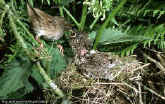
The large cuckoo chick (right) is being fed in its
nest by a much smaller adult bird (left). This is a good example of
brood parasitism. This occurs when a bird lays its eggs in the nest of a
member of its own, or another, species. The host bird will raise the young,
who may eventually eject from the nest, or even kill, the host’s own
natural offspring. Brood parasitism is common in this species.
Eric and David
Hoskings/Corbis
|
|
Cuckoo
|
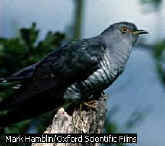
Young cuckoos are reared by foster parents. The adult female
cuckoo chooses another bird’s nest with eggs of a similar shape, size, and
colour to her own. She removes an egg and lays one in its place, carrying
the stolen egg away with her. The young cuckoo almost always hatches before
the other eggs in the nest. It ensures that the foster parents devote their
energy to it by ejecting other eggs or chicks from the nest, or trampling on
them. The call of the common European cuckoo, Cuculus canorus,
pictured here, is popularly held to signal the beginning of spring.
Mark
Hamblin/Oxford Scientific Films/BBC Natural History
Sound Library. All rights reserved.
|
|
Common Hippopotamus
|
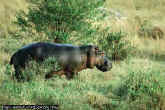
The hippopotamus divides its time between water and land.
During the day, its unusually thin outer layer of skin allows moisture to
escape too quickly for the animal to remain out of water for very long.
Instead of sweat glands, the skin has glands that secrete a thick, reddish
fluid impenetrable by the sun’s burning rays; for this reason, hippos have
been said to "sweat blood". Hippopotamuses spend the night on
land, foraging for the roughly 40 kg (88 lb) of food they consume a day.
Mark
Hamblin/Oxford Scientific Films/BBC Natural History
Sound Library. All rights reserved.
|
|
Secretary Bird
|
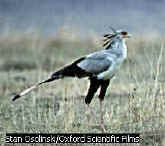
The secretary bird, a bird of prey found in open areas and
savannah regions south of the Sahara desert, feeds primarily on insects,
rodents, and snakes. Although the secretary bird is an excellent flier, it
spends most of its time on the ground.
Stan
Osolinski/Oxford Scientific Films/BBC Natural History
Sound Library. All rights reserved.
|
|
Giant Anteater
|
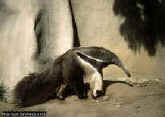
Anteaters are native to Central and South America,
inhabiting both forest and open-plain regions. The giant anteater, above,
is the largest of the species, weighing up to 23 kg (50 lb). The animal is
well adapted to hunt for insects, its sole source of food, because of its
long front claws and sticky tongue, which can extend to 60 cm (24 in).
Miriam
Austerman/Animals Animals/Library of Natural Sounds,
Cornell Laboratory of Ornithology. All rights reserved.
|
|
Common Puffin
|
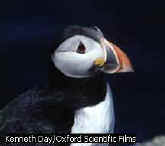
The common puffin, which ranges from the north-western coast
of Greenland to Maine, United States, and along the northern coast of
Europe, spends most of the year at sea, returning to land only to breed and
rear its young. Skilled fliers and fishers, puffins "fly"
underwater to catch fish. Their webbed feet are only used to swim at the
surface.
Kenneth Day/Oxford Scientific Films/BBC Natural History
Sound Library. All rights reserved.
|
|
Humpback Whales
Humpback and Northern
Right Whales
Virtual Whales
|
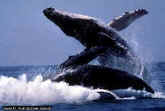
Whales are classified into two groups—toothed whales, such
as dolphins and sperm whales, and baleen whales, such as blue or humpback, above.
Baleen whales have baleen plates hanging from their upper jaws that allow
them to filter plankton out of the tons of water they take into their
mouths. Plankton, tiny organisms that live in water, are the only food
source of baleen whales.
James D. Watt/Animals Animals/Library of Natural Sounds,
Cornell Laboratory of Ornithology. All rights reserved.
|
|
Broad-Tailed Hummingbird
|
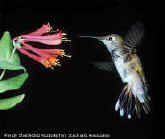
This broad-tailed hummingbird, Selasphorus platycercus,
hovers alongside a honeysuckle flower, creating its characteristic humming
sound with its wings. The specialized skeletal structure of the hummingbird,
shared only by its relative the swift, allows its wings to twist. Able to
produce 22 to 78 of these wing movements per second, the bird can hover
forwards and backwards while it drinks nectar from a flower. Hummingbirds
belong to the Trochilidae family of birds, which contains the smallest birds
in the world.
Wendy
Shattil-Bob Rozinski/Tom Stack and Associates/Library
of Natural Sounds, Cornell Laboratory of Ornithology. All rights reserved.
|
|
Great Northern Diver (Common Loon)
|
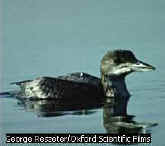
Awkward on land, the common loon, Gavia immer,
belongs to a family of highly specialized divers. By inflating or deflating
their lungs and air sacs, loons can make themselves more or less buoyant in
the water. They can stay under water for several minutes at a time, diving
to a depth of up to 80 m (265 ft). Usually, however, they use their webbed
feet to move quickly through shallower waters in pursuit of the fish,
crustaceans, and amphibians they commonly prey upon. Chicks are able to dive
less than 24 hours after hatching.
George
Reszeter/Oxford Scientific Films/Library of Natural
Sounds, Cornell Laboratory of Ornithology. All rights reserved.
|
|
Tasmanian Devil
Tasmanian Devil
(Sarcophilus harrisir)
|
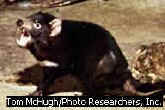
The Tasmanian devil, exterminated on the Australian
mainland, is now found only on the island of Tasmania. A carnivorous
marsupial, the Tasmanian devil is capable of completely consuming birds and
small- to medium-sized mammals, including all the bones.
Tom McHugh/Photo Researchers, Inc./BBC Natural History Sound
Library. All rights reserved.
|
|
Mammalian Limb Structure
|
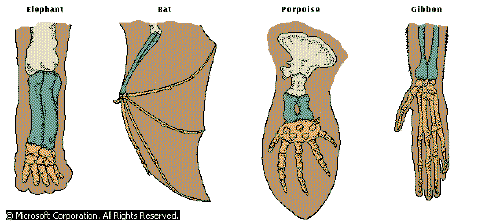
A common mammalian skeletal structure is modified for each
animal’s particular needs. Here, the bones of the forelimb are adapted to
each creature’s particular mode of locomotion. From left, the elephant’s
immense weight requires a sturdy support to carry it. In contrast, a bat’s
wing stretches over a framework of thin, elongated finger bones. The
forearms of aquatic mammals such as porpoises and whales form flippers, and
the gibbon uses its jointed, flexible digits to grasp and swing through
trees.
© Microsoft Corporation. All Rights Reserved.
|
Next 10 Animals and Bird
[Documentary] [Home] |


