|
   
|
Begonia
|
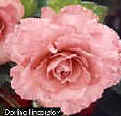
Most begonias belong to a highly diverse genus of flowers,
native to the Tropics but popular in households and gardens around the
world. The cultivated variety pictured here is called Roy Hartley.
Dorling Kindersley
|
|
Snapdragon
|
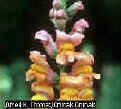
The snapdragon has two-lipped flowers, and when the lips,
said to resemble the mouth of a dragon, are pulled apart and released, they
snap shut—hence the plant’s name. Horticulturalists have developed many
strains of snapdragons with various colours and fragrances for ornamental
use.
Alfred B. Thomas/Animals Animals
|
|
Black-Eyed Susan
|
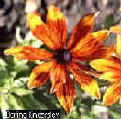
The black-eyed Susan, a species of coneflower, grows wild in
dry areas throughout the United States and is widely cultivated for its
colourful flowers. The plant has stiff, hairy leaves and tough stems. Its
blossoms are composite flowers, with the central disc and radiating petals
themselves made of clusters of tiny, separate flowers.
Dorling Kindersley
|
|
Corpse Lily
|
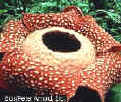
The Rafflesia arnoldii, or corpse lily, is the
largest flower in the world, weighing up to 7 kg (15 lb) and measuring up to
91 cm (36 in) wide. Found in Malaysia and Indonesia, the flowers emit the
stench of rotting meat to attract certain flies.
Bios/Peter Arnold, Inc.
|
|
Bleeding Heart

|
The bleeding heart known as Dutchman's breeches, grown
primarily for its ornamental heart-shaped flowers, thrives in semishade and
fertile, well-drained soils. Various species bloom in yellow, white, or
various shades of red and the hardy plant can thrive for years if
undisturbed.
Deni Bown/Oxford Scientific Films
|
|
Dutch man's Breeches
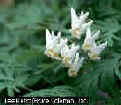
|
The distinctive flowers of Dutchman’s breeches, originally
from Japan, resemble trousers hung out to dry. This perennial wildflower
grows from small, potato-like tubers and can reach 25 cm (10 in) in height.
Populations of Dutchman’s breeches are dwindling because of overcollecting
for floral arrangements.
Lee Rentz/Bruce Coleman, Inc.
|
|
Lily of the Valley
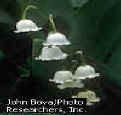
|
The Convallaria majalis, known as the lily of the
valley, is a perennial herb found in Europe and is popular for shady
gardens. It has long-stalked oval leaves and a stem of several white
flowers. These tiny, aromatic, bell-shaped flowers are used in the
manufacture of perfume.
John Bova/Photo Researchers, Inc.
|
|
Daisies in Bloom
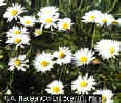
|
The daisy, a carpeting, slow-growing perennial flower, grows
to a height of up to 20 cm (8 in) with a flower width of 2.5 cm (1 in). Some
varieties are cultivated as garden flowers, and are also popular in the
floral industry.
G.A. Maclean/Oxford Scientific Films
|
|
Roses
Rose Garden
Rose Page
The
Puppetry Home Page
Yesterday's
Rose
|
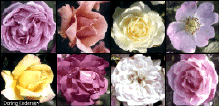
The more than 20,000 varieties of cultivated rose are
carefully bred for qualities such as number and shape of petals. Pictured
here are (top, left to right) Mrs. John Laing (perpetual, blooming in
early summer and again in autumn), Just Joey (hybrid tea, with just a few
large blossoms on each plant), Iceberg (floribunda, a cluster-flowered bush
rose), Eglanteria (wild, with a thorny stem and a single layer of five
petals in each flower); (bottom) Peace (hybrid tea), Old Blush China
(China rose, blooming once a season), the Fairy (polyantha, a leafy shrub
with clusters of dwarf blossoms), and Mme. George Staechelin (climbing, its
many-blossomed arching vines trainable to trellises and fences).
Dorling Kindersley
|
|
Dicot Versus Monocot
|
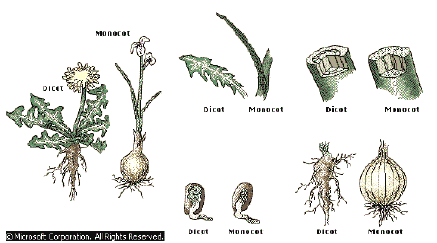
The two subclasses of angiosperms, or flowering plants,
differ in a number of ways. Dicotyledons, represented here by the dandelion,
have floral organs (sepals, petals, stamens, pistils) in multiples of four
or five. In contrast, the floral organs of the iris and other monocotyledons
generally occur in multiples of three. The leaves of dicots have a netlike
vein pattern, while those of monocots have parallel veining. The vascular
tissue (xylem and phloem) inside the stem of a dicot is arranged in a ring.
Inside a monocot stem, xylem and phloem are scattered. Dicot seeds have two
seed leaves, or cotyledons, that nourish the growing seedling, where
monocots have only one. The stem and root of dicots expand with secondary
growth, adding vascular cambium and secondary xylem and phloem; monocots
show no secondary growth.
© Microsoft Corporation. All Rights Reserved.
|
|
Anatomy of a Flower
Flower base Introduction
to the Anthophyta Flowering
Plant Family Access Page
|
|
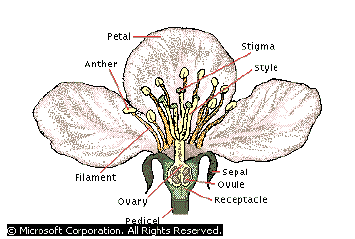
A flower consists of up to four types of modified leaves.
Sepals, closed over the bud before it blooms, are outermost. Inside the
sepals are the petals. These serve to attract pollinators, both by coloration
and by scent-producing glands. Inside the petals are one or two circles of
pollen-producing stamens, the flower’s male reproductive organs. The
carpels, composed of stigma, style, ovary, and ovule, are innermost. The
carpel receives pollen grains and, after fertilization, swells to form fruit.
The carpel is believed to have evolved for protection from ovule-eating
insects and other harmful elements of the environment.
© Microsoft Corporation. All Rights Reserved.
|
Next 10 Flowers
[Documentary] [Home] |


