|
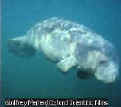
West Indian Manatee
|
Commonly called a sea cow, the docile manatee has adapted
well to its herbivorous life-style. Dexterous flippers, with their vestigial
nails, help the animal to grasp and dig up deeply rooted aquatic plants.
Because most of these plants contain silica, which wears the teeth down
quickly, manatees have a unique dental solution: at a rate of about 1 mm
(0.039 in) a month, the molars move towards the front of the jaw. They fall
out when completely worn and are replaced by new teeth at the back of the
jaw.
Godfrey Merlen/Oxford Scientific Films
|
|
Bottle-Nosed Dolphins
Bottlenose
Dolphins
Dolphin Research Institute,
Inc Dolphin - The Oracles
of the Sea Speeches by
Newton L. Gingrich
|
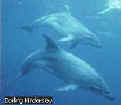
The bottle-nosed dolphin belongs to a group of marine
mammals known as the toothed whales (Odontoceti). It has a pronounced beak,
high dorsal fin, and broad tail flukes. Bottle-nosed dolphins are
approximately 1.2 m (4 ft) long at birth and grow to a maximum size of 3 to
4 m (10 to 13 ft). There are 32 species of dolphins found throughout the
world in all oceans and seas except arctic and antarctic waters. Several
freshwater species are also known.
Dorling Kindersley
|
|
Common Dolphin
|
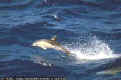
The common dolphin, Delphinus delphis, is found
world-wide in tropical and warm temperate waters. It travels in schools that
sometimes number in their hundreds or even thousands. Females give birth to
a single calf about 95 cm (3 ft) in length. Adults grow to 2.5 m (8 ft) in
length and 175 kg (385 lb) in weight. Common dolphins can swim at speeds of
over 35 km/h (20 mph).
K. Findlay, Zoology Department/University of Cape Town
|
|
Tidal Pool
|
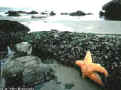
The fluctuation of the tide allows for a unique environment
along shorelines. The current continually circulates and replenishes a rich
supply of nutrients along beaches, but organisms living there must be
adapted to both buffeting waves and frequent shifts from open air to
complete submersion. Marine organisms adapt to the constantly changing
surroundings in a variety of ways. Starfish use suction-cup feet, barnacles
fix permanently to large objects like rocks and boats, and seaweed anchors
firmly to the ocean floor. When the tide goes out, pockets of water remain
trapped in rocks, depressions in the sand, and natural basins called tidal
pools, like the one shown here during low tide.
Pat O'Hara Photography
|
|
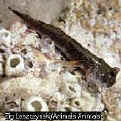
Mudskipper
|
Mudskippers are fish that can propel themselves over land by
using their pectoral fins as legs. They can remain out of water for several
days by breathing air trapped in highly vascularized cavities in the mouth
and gill chambers. They use this special ability to feed on the rich supply
of crustaceans present in the mud of mangrove swamps and estuaries.
Mudskippers inhabit the tropical coastal regions in the Indian and Pacific
oceans.
Zig Leszczynski/Animals Animals
|
|
Scallop

|
Scallops are bivalve molluscs related to oysters, clams, and
mussels. The circular white muscle tissue dominating the interior of the
shell has a flavour and texture that make the scallop one of the most prized
of all seafoods.
Dorling Kindersley
|
|
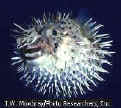
Spiny Buffer
|
The spiny puffer, or burrfish, has a unique defensive
mechanism that protects it from predators. When threatened, it inflates its
body with water or air, which erects the numerous long spines covering its
body. The inflated body and the sharp spines make it difficult for a
predator to swallow the puffer. When the danger has passed, the puffer
slowly deflates itself and resumes a more normal shape.
J.W. Mowbray/Photo Researchers, Inc.
|
|
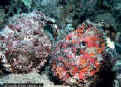
Stonefish
|
With venom powerful enough to kill human beings, stonefish
are the deadliest fish in the sea. Their squat bodies camouflage them well
against coral and mud and allow them to surprise small fish and other prey.
Found in tropical waters, stonefish use their poisonous spines only in self-defence.
Carl Roessler/Bruce Coleman, Inc.
|
|
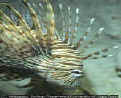
Lionfish
|
The venomous lionfish, Pterois miles, is the most
spectacular member of the rockfish, or scorpion-fish, family. Its elaborate
fins are supported by long, thin, hollow spines, each of which is connected
to a venom sac. When threatened by a predator or handled by humans, these
spines act like hypodermic needles, injecting the intruder with a toxin that
causes excruciating pain and results in swelling.
C. Velasquez, Zoology Department/University of Cape Town
|
|
Sea Spider
Introduction
to the Pycnogonida
|
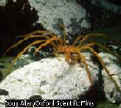
Sea spiders are marine species found from the intertidal
region to the deep-sea floor. They have two pairs of eyes, three pairs of
legs, and sex organs located in the legs.
Doug Allan/Oxford Scientific Films
|
|
Manta Ray
|
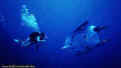
The manta ray, or devilfish, is the largest species of ray,
growing to a width of at least 6 m (20 ft) and a weight of more than 750 kg
(1,500 lb). In spite of its large size, the manta ray is a filter feeder,
straining planktonic organisms and small fish out of the water with its
wide, gaping mouth. Unlike other types of rays, the manta ray lacks a spine
on its tail.
Howard Hall/Oxford Scientific Films
|
|
Globular Sponges
Introduction
to Porifera
|
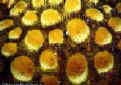
The globular sponges pictured here were found off the
islands of Indonesia. The calcareous (containing or consisting of calcium)
deposits left by these and other sponges help build reefs.
Dale Knuepfer/Bruce Coleman, Inc.
|
|
Purple and Yellow Tube Sponge
Introduction
to Porifera
|
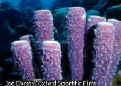
The purple and yellow tube sponge displays one of the many
different body forms typical of sponges. Sponges, considered to be the most
primitive of the multicellular animals, are represented in the fossil record
back to the Cambrian Period, at least 570 million years ago. The interior
body cavities of sponges provide shelter for a variety of small crabs, sea
stars, and other marine invertebrates.
Joe Dorsey/Oxford Scientific Films
|