|
Octopus
   
In search of the Giant
Octopus
The Common Sand
Dollar The Life
History of the Bluefish
|
|
Anglerfish
|
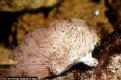
Anglerfish have appendages that serve as "fishing
rods," or lures to attract prey, mainly other fish. They are found in
oceans throughout the world and generally inhabit deep waters. Certain
species can grow to lengths of about 1.5 m (5 ft), and have huge mouths
capable of swallowing prey as large as the anglerfish itself.
Zig Leszczynski/Animals Animals
|
|
Seaweed
  
Palmaria
palmata (Linnaeus) Kuntze
Seaweed
Seaweeding:
Garden Under Sea
|
|
Lantern fish
|
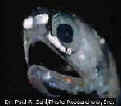
Lanternfish derive their name from the light-producing
organs, or photophores, on their bodies. The function of the photophores is
not fully understood, although each species has a characteristic arrangement
of photophores, which is an important means of species identification.
Lanternfish are deep-sea fish, but migrate to surface waters to feed at
night.
Dr. Paul A. Zahl/Photo Researchers, Inc.
|
|
Beluga Whale
Beluga Whale
|
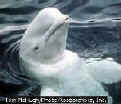
Also called "canaries of the sea" because of their
loud, shrill squeaks and chirps, beluga whales live in the upper parts of
the northern hemisphere, in estuaries and near pack ice. The
"hump" at the front of the beluga whale’s head changes shape and
size in accordance with the different sounds emitted by the whale. In North
America, belugas are popular attractions in public aquariums and oceanariums
because of their playful and "talkative" demeanour.
Tom McHugh/Photo Researchers, Inc.
|
|
Diatoms
Diatoms: Phytoplankton made
of glass Introduction
to the Bacillariophyta
|
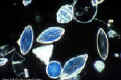
Diatoms represent a significant group of marine plant making
up the phylum Bacillariophyta. They are single-celled and have a cell wall
made of silica, which is essentially glass. The diatoms, and other aquatic
single-celled plants, form the phytoplankton, which are the base of the
marine food chain.
Peter Parks/Oxford Scientific Films
|
|
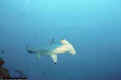
Hammerhead Shark
|
The hammerhead shark, distinguished by the lateral expansion
of the head into a hammer-shaped structure, on the ends of which are placed
the eyes and nostrils, is perhaps the most easily recognized of the 360 or
so species of living sharks. The great hammerhead roams tropical and
subtropical seas feeding on stingrays, bony fish, and invertebrates. It is
known for its unprovoked attacks on humans.
F. Stuart Westmorland
|
|
River Lamprey
|
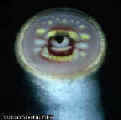
The river lamprey is one of a number of lampreys common to
North America and its surrounding waters. Most species of river lamprey are
not parasitic. All lampreys spend the first four years of their lives,
during which they are known as ammoecetes larvae, living as filter feeders
buried in the mud at the mouths of small streams and rivers. Eventually they
metamorphose into the adult form. In nonparasitic lampreys, such as the
river lamprey, the adult stage does not feed; it merely spawns and dies. The
lamprey shown here is facing the viewer with its mouth completely open.
Oxford Scientific Films
|
|
Sea Lamprey Clings to a fish
|
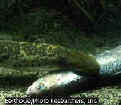
The sea lamprey, a vertebrate parasite, belongs to the most
primitive group of living fish, the agnathans, or jawless fish. In this
species the lower jaw is missing and the upper jaw is modified into a
sucking disc. The lamprey feeds on blood by using this disc to attach itself
to another fish and drilling a small hole into the fish’s side with its
small, muscular tongue. The parasitic action rarely kills the host, but
wounds caused by lampreys often become infected.
Berthoule/Photo Researchers, Inc.
|
|
Polar Bear on an Ice Floe
Polar Bears
(Sea World)
Polar Bears (The Bear
Den)
|
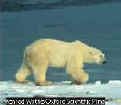
The polar bear, the largest of the terrestrial carnivores,
is found along the northernmost coasts of the northern hemisphere as well as
on sea ice and islands. Polar bears are strong swimmers, paddling with their
front legs and steering with the back legs. They have been known to swim as
far as 80 km (50 mi). On land polar bears easily cover distances of up to 80
km (50 mi) a day and 1,100 kilometres (690 mi) a year.
Konrad Wothe/Oxford Scientific Films
|
|
Polar Bear, Manitoba
Polar Bears
(Sea World)
Polar Bears (The Bear
Den)
|
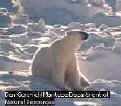
Polar bears congregate on the snow-covered shores of Hudson
Bay in the north-east of the Canadian province of Manitoba. Despite their
reputation as fierce wild predators, polar bears have become well adapted to
the human presence in some areas of northern Canada, raiding domestic
rubbish and providing a popular sight for tourists.
Dan Guravich/Manitoba Department of Natural Resources
|
|
Generalized Anatomy of a Crustacean
|
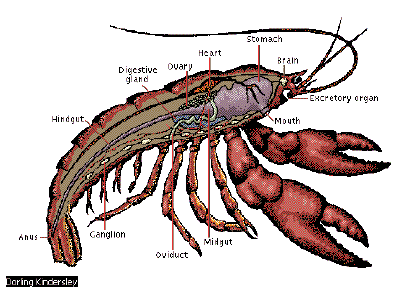
A crustacean’s body cavity is little more than a dorsal
heart and a blood circulatory system. In the tubular gut, which leads to the
anus in the tail portion, can be found the two digestive glands. Near the
sense organs sits the brain which is in the form of ganglia. A collection of
ganglia and major nerves is found below the gut.
Dorling Kindersley
|
|
Hydrozoan's Jellyfish
|
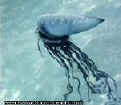
The notorious Portuguese man-of-war, Physalia physalia,
a hydrozoan jellyfish, is propelled on the surface of warm seas by the force
of the wind on its blue, gas-filled float. Stinging tentacles, as long as 20
metres (65 ft) or more, hang from polyps on the underside of the float.
These tentacles contain nematocysts, capsules that launch toxic, numbing
threads for capturing prey, which can seriously and even fatally injure
people. Stinging polyps transfer prey to feeding polyps for digestion.
Peter Parks/Oxford Scientific Films
|
|
Obelia Colony
|
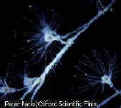
Cnidarians of the genus Obelia form colonies of
polyps in one stage of their asexual reproduction. There are two kinds of
polyps, feeding and reproductive. They bud but do not separate from an
upright, anchored stalk, remaining instead as the branchlike structures seen
in this picture. Each polyp, called a subindividual because its activity is
governed by that of the entire colony, has a transparent, horny covering
into which it can withdraw. The two types of polyp differ in other aspects
of their structure. Only feeding polyps have tentacles with which to draw
food towards them, but because both types of polyp are hollow, partially
digested food can travel through the colony’s continuous digestive cavity
to nourish the reproductive polyps. The medusa, or sexual stage of the
organism, emerges from the opening of the reproductive polyp as a
saucer-shaped mass of jelly.
Peter Parks/Oxford Scientific Films
|