|
   
|
Primate
  
Primate Info Net
Primate Gallery
|
|
Marsupial
     
Marsupial
Mammals
|
|
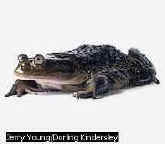
North American Bullfrog
|
The characteristic call of the North American bullfrog is
used to attract females for mating. Following mating, the females deposit as
many as 10,000 eggs in quiet, protected waters. The eggs hatch into small,
spotted tadpoles.
Jerry Young/Dorling Kindersley/BBC Natural History Sound
Library. All rights reserved.
|
|
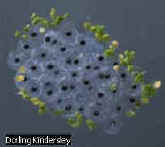
Amphibian Eggs in Water
|
A mass of amphibian eggs, appearing as small black spots, is
contained within a gelatinous mass while they incubate in a freshwater pond.
Eggs deposited in this fashion receive little or no parental protection and
will soon hatch into small, wriggling tadpoles.
Dorling Kindersley
|
|
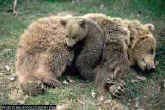
European Brown Bear
|
The European brown bear is found in isolated open plains from
Norway to the Siberian peninsula and as far south as Greece. Cubs stay with
the mother for two years or more and learn from her how to hunt and find
food. A female becomes aggressive if she feels her cubs are under threat.
However, bears do not deserve their reputation for ferocity, as they attack
only when alarmed or frightened.
Ojuro Huber/Oxford Scientific Films
|
|
Elephant
   
Discovering
Laos: The land of a Million Elephants
Elephant Man, The (1980)
Introduction
to the Proboscidea
The Elephant of the
Africa
The Elephant of the Cameroon
Tusk, Tusk:
Lifting the ban on ivory
Wuchereria
bancrofti: The causative agent of Bancroftian Filariasis
|
|
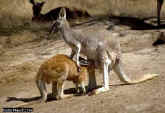
Red Kangaroo and Joey
|
Kangaroos are born hairless and immature, without ears, eyes,
or hind legs. The young kangaroo, or joey, develops inside its mother’s
pouch for five to nine months. After leaving the pouch, it continues to
suckle by placing its head inside the pouch. From then on, the male joey will
develop more quickly than the female.
Buddy Mays/Corbis
|
|
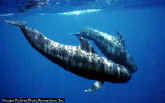
Pilot Whales
|
The gregarious nature of pilot whales supports a highly
developed social structure, in which the whales gather into specific groups
for travelling, feeding, and mating. The group responds to the cries of
injured animals, often following them into danger. This tendency makes groups
of pilot whales particularly susceptible to whaling and to mass stranding.
Douglas Faulkner/Photo Researchers, Inc./Library of Natural
Sounds, Cornell Laboratory of Ornithology. All rights reserved.
|
|
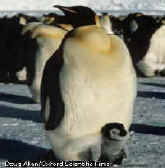
Penguin
Keeping Its Young Warm
|
Penguins always return to their ancestral nesting sites to
lay their eggs and rear their young. The emperor penguin, the largest of the
penguins, lays its single egg during the coldest time of the year, when
temperatures drop as low as -66° C (-80° F). The egg is incubated on top of
the parent’s feet, protected by abdominal folds of skin. Young chicks
remain under these abdominal folds for a short time until they are able to
regulate their own body temperature.
Doug Allan/Oxford Scientific Films
|
|
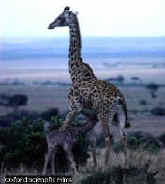
Giraffe
|
Female giraffes, Giraffa camelopardalis, give birth in
one of several specific "calving areas" in their home ranges,
returning to these grounds to bear subsequent calves even if the larger home
range has drifted geographically. Here, a young giraffe suckles from its
mother. Strong and well-developed at birth, calves nonetheless frequently
fall to predators in their first year of life. After weaning, females stay
within their mothers’ territories, whereas males leave the range in
all-male groups. Once a dominance hierarchy has been established among them,
they wander alone in their own small ranges in search of females in heat. The
sex of a grazing giraffe can be determined at a great distance with
considerable accuracy. Almost invariably, males feed with their necks and
often their tongues completely outstretched to reach the foliage of very tall
trees. In contrast, females bend their heads over the tops of smaller trees.
Oxford Scientific Films
|
[Documentary] [Home] |


