|
  
|
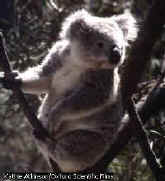
Koala
|
The Koala, native marsupials of Australia, are herbivores
that live in trees. They can be found only in eucalyptus forests of eastern
Australia, feeding on the leaves and flowers of certain species of
eucalyptus. Koalas are protected by law in Australia.
Kathie Atkinson/Oxford Scientific Films
|
|
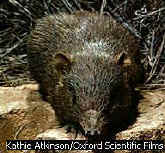
Bandicoot
|
The golden bandicoot, a marsupial, or pouched mammal, lives
only in Australia. Golden bandicoots are distinguished from all other
marsupials by the presence of fused toes on the hind legs, which act as
grooming devices.
Kathie Atkinson/Oxford Scientific Films
|
|
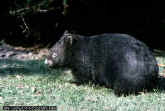
Wombat
|
The wombat is only found in northern Queensland and
southeastern and south central Australia, Flinders Island, and Tasmania. It
lives in temperate forests, mountainous areas, or open uncultivated
rangelands with poor, coarse soils. All wombats live in extensive, complex
burrows, which they excavate with their short, powerful legs and strong
claws. In some areas of Australia, wombats are considered pests, because
their digging damages rabbit-proof fencing.
John Cooke/Oxford Scientific Films
|
|
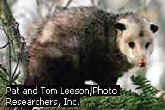
Opossum
|
The Virginia opossum, Didelphis virginiana, is found
in North, Central, and South America. Highly adaptable, this opossum thrives
in woodlands, farmlands, and even in towns and cities. Although generally
terrestrial, it occasionally nests in hollow trees.
Pat and Tom Leeson/Photo Researchers, Inc.
|
|
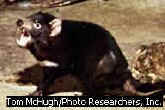
Tasmanian Devil
|
The Tasmanian devil, exterminated on the Australian mainland,
is now found only on the island of Tasmania. A carnivorous marsupial, the
Tasmanian devil is capable of completely consuming birds and small- to
medium-sized mammals, including all the bones.
Tom McHugh/Photo Researchers, Inc.
|
|
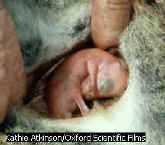
Parma
Wallaby in Pouch
|
Although this two-month-old parma wallaby joey is safely
curled up in its mother’s pouch and will be for several more months, not
all marsupial young enjoy such complete protection. The pouches of other
marsupials, including the opossum and many Australian carnivores, are simply
ridges of skin surrounding the nipples. As soon as the young are able to open
their jaws and release the nipple, they are left in a nest while the mother
forages for food. Marsupials weigh less than 1 g (0.035 oz) at birth, a fact
that makes their first blind journey to the pouch seem all the more
hazardous.
Kathie Atkinson/Oxford Scientific Films
|
Web links
Marsupial
Mammals
|
[Animals Babies] [Documentary]
[Home] |


