|
   
|
Red Howler Monkey

|
This young red howler, Alouatta seniculus, has not
yet grown the long black beard its elders wear and may not live long enough
to do so. A new male that moves in to dominate a troop often kills young
members already present. Despite this seemingly counterproductive breeding
strategy, the howler monkey is one of the most widely distributed New World
primates. It is successful largely because of its ability to survive on
nutrient- and sugar-poor leaves, a diet more abundant than that of other
species.
Aldo Brando Leon/Oxford Scientific Films/BBC Natural History
Sound Library. All rights reserved.
|
|
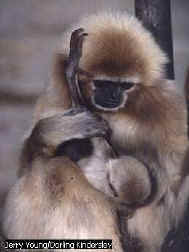
Gibbon
|
This one-month-old gibbon will not be self-sufficient for
three or four years and will remain with its family group even after that.
Gibbons spend most of their lives in the treetops, sleeping unsheltered but
invisible among the leaves. They are noted for their fear of water. Habitat
destruction and the capture of their young for food and pets have placed two
species, Kloss’s gibbon and the pileated gibbon, on the endangered species
list.
Jerry Young/Dorling Kindersley/BBC Natural History Sound
Library. All rights reserved.
|
|
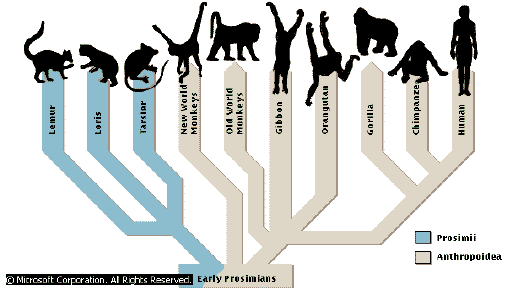
Evolution of Modern Primates
|
The order Primata consists of two suborders, prosimians and
anthropoids. Anthropoids arose from the descendants of early prosimians, but
prosimians themselves have changed very little in 50 million years.
Characteristics shared by primates include opposable thumbs (and usually big
toes), frontally directed eyes with binocular vision, large and convoluted
brains, and complex social behaviour.
© Microsoft Corporation. All Rights Reserved.
|
Web Links
Primate Info Net
Primate Gallery
|
[Animals Babies] [Documentary]
[Home] |


