|
  
|
Common Octopus
Common Sand
Dollar
|
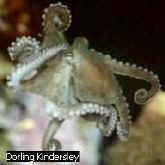
The common octopus has the typical octopus body form,
consisting of three main regions: the mantle, limbs, and head. The mantle, a
large, muscular, bulbous sac, contains most of the internal organs,
including the gills, digestive tract, ink sac, and reproductive organs. The
limbs consist of eight tentacles. Along the length of each tentacle is a
double row of suckers equipped with tactile and olfactory receptors.
Dorling Kindersley
|
|
Octopus Eye
|
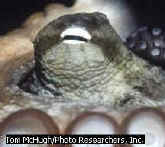
The octopus has the best-developed eye in the invertebrate
world. In structure and function it is very similar to that of fish,
mammals, and human beings. The octopus is primarily a visually guided
feeder, preying on such organisms as fish, crabs, shrimp, clams, snails, and
other octopuses. Yet it does much of its feeding at night.
Tom McHugh/Photo Researchers, Inc.
|
|
White-Spotted
Oktopus
|
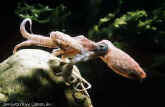
The female white-spotted octopus lays about 150,000 eggs in
two weeks, after mating. The young, when hatched, are only about 3 mm long.
They live on the surface of the water for about a month, then sink and begin
their normal life at the bottom of the ocean.
Jane Burton/Bruce Coleman, Inc.
|
|
Octopus
Ejecting Ink
|
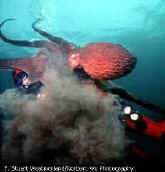
The octopus escapes from predators, such as fishes and
whales, by ejecting a cloud of ink into the water. The ink confuses
predators and masks the retreat of the octopus.
F. Stuart Westmorland/Norbert Wu Photography
|
[Marine Life] [Documentary]
[Home] |


