|
  
|
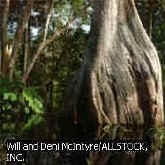
Amazon Rainforest
|
The Amazon rainforest, with an area of about 6 million sq km
(about 2.3 million sq mi), covers much of equatorial South America and
contains more species of flora and fauna than any other ecosystem in the
world. Trees constitute about 70 percent of the plant species found in
rainforests. Currently, the Amazon rainforest is being cleared at an
alarming rate for timber and agricultural purposes.
Will and Deni McIntyre/ALLSTOCK, INC.
|
|
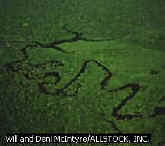
Tropical Rainforest
|
The Amazon, seen here, is the second longest river in the
world, and has the greatest number of tributaries. Its high rainfall and
year-round heat and sunshine ensure a profusion of all forms of life,
stratified into as many as five distinct layers, from the ground to the
canopy of the tallest trees.
Will and Deni McIntyre/ALLSTOCK, INC.
|
|
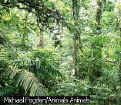
Interior of Rainforest, Costa Rica
|
equatorial forests of Amazonia or monsoon forests such as
this one in Costa Rica, tropical rainforests often provide the only home for
thousands of species of animals and plants, both known and as yet
undiscovered. Logging and agriculture are threatening the survival of
tropical rainforests throughout the world, and are causing the extinction of
many of the species that inhabit them.
Michael Fogden/Animals Animals
|
|
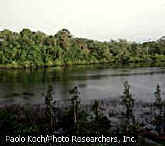
Deciduous Monsoon Forest
|
The deciduous monsoon forest is characteristic of the
northern Indian Ocean along the coasts of India, Burma, and Southeast Asia.
Typical throughout much of the year in such forests is heavy daily rainfall
with intermittent dry periods during which the deciduous trees shed their
leaves.
Paolo Koch/Photo Researchers, Inc.
|
|
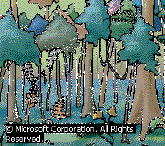
Vertical Stratification of a Rainforest
|
This illustration shows the characteristic vertical
stratification, or layering, of plants and trees in rainforests. Generally,
there are at least three discernible strata (layers) of plant growth in
rainforests. At the upper canopy level, the tops of trees reach heights of 30
to 50 m (100 to 160 ft), while outstanding emergents may tower to 60 m (200
ft); this layer is uneven, with breaks between treetops, allowing sunlight to
filter through to the middle layer. This middle layer, the densest layer of
the rainforest, includes another level of treetops, lianas (woody vines), and
epiphytes (plants that thrive on airborne nutrients). The growth at the
middle layer is so dense that little sunlight reaches the forest floor; only
1 per cent of the light above the upper canopy gets through to the floor.
Thus the lowest layer is also the thinnest, sparsely populated with tiny
seedlings and shoots. Each layer of flora houses its own faunal communities;
many animals live in ecological niches at one layer and never venture beyond
to other layers of the forest.
© Microsoft Corporation. All Rights Reserved.
|
|
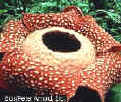
Corpse Lily, Kinabalu National Park
|
The Rafflesia arnoldii, or corpse lily, is the largest
flower in the world, weighing up to 7 kg (15 lb) and measuring up to 91 cm
(36 in) wide. Found in Malaysia and Indonesia, the flowers emit the stench of
rotting meat to attract certain flies.
Bios/Peter Arnold, Inc.
|
|
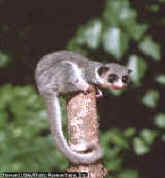
Greater
Dwarf Lemur
|
The greater dwarf lemur is one of four species of dwarf lemur
which are found only in the forests of the island of Madagascar. Being
nocturnal, its eyes are large and light-sensitive. Dwarf lemurs hibernate
during the dry season, when food is scarce, and live off of fat stored in
their long tails.
Howard Uible/Photo Researchers, Inc.
|
|
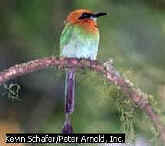
Broad-Billed
Motmot
|
The tail of the broad-billed motmot, like that of all
motmots,
is trimmed near the end, giving the tail the appearance of a tennis racket.
The birds, found in the tropical forests of Central and South America, trim
these feathers to maintain the shape and swing them from side to side in a
rhythmic fashion, appearing like a metronome. The reason for this behaviour
remains a mystery to zoologists.
Kevin Schafer/Peter Arnold, Inc.
|
|
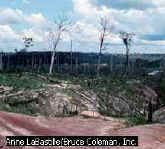
Destruction
of Amazonian Rainforest
|
This area of the Amazon rainforest has been cleared by
burning, following which a ground cover of small plants grew quickly, but
could not prevent the rapid erosion of the soil by rain water, the signs of
which can be seen in the channels leading down to the central gully. The fast
erosion of already nutrient-poor soil makes regeneration of the forest an
even more precarious prospect.
Anne LaBastille/Bruce Coleman, Inc.
|
|
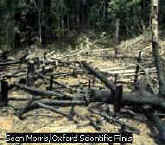
Slash
and Burn Deforestation
|
The deforestation technique of slash and burn, utilized
extensively to clear large areas of forest for agricultural and other
purposes, causes an enormous amount of environmental damage. The large
amounts of carbon dioxide given off into the atmosphere during burning adds
to the greenhouse effect. The removal of all trees and groundcover destroys
animal habitats and greatly accelerates erosion, adding to the sediment loads
of rivers and making seasonal flooding much more severe.
Sean Morris/Oxford Scientific Films
|
Web Links
The Tropical
Ecology Web Site
The Tropical
Rainforest in Suriname
|
[Wild Life of the
Rainforest] [Documentary] [Home] |


