|
Tropical
Rainforest


The Tropical
Ecology Web Site
The Tropical
Rainforest in Suriname
|
|
River Amazon, Brazil
|
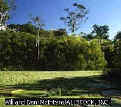
The Victoria amazonica is the largest water lily in
the world. Located in the Amazon, this lily grows leaves that range from
about 0.5 to 2 m (2 to 6 ft) in diameter. The lilies provide food for fish
and wildlife in the Amazon region, but can also cause drainage problems
because of their large size.
Will and Deni McIntyre/ALLSTOCK, INC.
|
|
Rainforest, Costa Rico
|
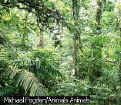
Much of the soil in which rainforests develop is poor, but
nutrient paucity is overcome by nutrient recycling.
Michael Fogden/Animals Animals
|
|
Fern


American Fern Society
Emilio
Fernandez
Fernando
Rey
Introduction
to the Psilotales
|
|
Spanish Moss
|
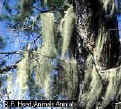
Spanish moss, an epiphyte (air plant), does not root
in soil, but instead attaches itself to trees. The plant hangs from the
branches and trunks of oak trees in South America and the southeastern United
States. Like other epiphytes, Spanish moss absorbs water directly from the
air and secures nutrients from drifting dust particles.
R.F. Head/Animals Animals
|
|
Indian Rock Python
|
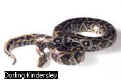
The Indian rock python feeds on warm-blooded animals. Like
other constrictors, this snake wraps its muscular body tightly around its
prey to suffocate it. Indian pythons grow to a length of about 4 m (13 ft),
although larger individuals have been reported. Pythons are members of the
most primitive group of living snakes; they may hiss, but are essentially
deaf and mute.
Dorling Kindersley
|
|
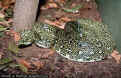
Australian Diamond Python
Ball Python
(Royal Python) Species Data Sheet)
|
The diamond python, so named because of the diamond-shaped
markings on its back, is native to Australia and New Guinea. Its coloration
is usually yellow and black but it is also known in a variety of other
colours. It grows to a length of up to 4.2 m (14 ft).
Kenneth W. Fink/Photo Researchers, Inc.
|
|
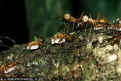
Army Ants on the March
|
Developing army ant larvae (in white) are transported beneath
the bodies of worker ants while in transit to a new bivouac, or temporary
location. After the larval stage, ants experience a pupal stage before the
final metamorphosis into mature adulthood. Male adults generally die after
mating, while in some species female ants have been known to survive as long
as 15 years.
G. G. Dimijian/Photo Researchers, Inc.
|
|
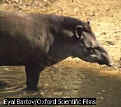
Tapir
tAPir-the Anxiety-Panic
internet resource
|
Tapirs, found in dense forests and swampy areas of Central
and South America and Asia, are moderately large mammals, growing to a height
of 75 to 120 cm (29 to 47 in) and a weight of 225 to 300 kg (500 to 600 lb).
The nocturnal animals feed on leaves, grasses, aquatic vegetation, soft
twigs, and fruit, using their short flexible snouts to roll up leaves and
other vegetation.
Eyal Bartov/Oxford Scientific Films
|
|
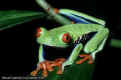
Red-Eyed Leaf Frog
|
The red-eyed leaf frog is one of the many species of
rainforest tree frogs that have adhesive toe pads. This modification of the
toes of the front and hind legs allows these small frogs to adhere to the
undersides of leaves and to crawl up tree trunks and other vertical surfaces
with relative ease.
Michael Fogden/Oxford Scientific Films
|