|
  
|
African
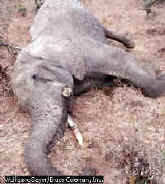
Elephant Killed by Poachers
|
Elephant populations are on the brink of extinction due to
poachers who kill elephants for their ivory tusks. An international ban on
ivory trade, instituted in 1989 by the Convention on International Trade in
Endangered Species of Wild Fauna and Flora (CITES), has diminished the
illicit ivory trade and reduced the killing. Over 120 countries support the
ban.
Wolfgang Bayer/Bruce Coleman, Inc.
|
|
Elephant Emotions
|
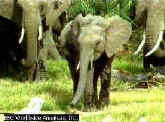
Researchers are just beginning to understand the complex
emotional life of elephants. In addition to mourning their dead, elephants
celebrate the birth of a baby elephant, and display excitement when greeting
family members.
BBC Worldwide Americas, Inc.
|
|
Social
Structure of Elephant
|
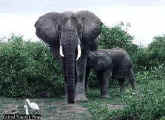
Elephants are social animals and associate in small troops
for protection from predators. Each elephant family unit is led by the
dominant female, or matriarch. When threatened, the members of the troop
will surround the calves to protect them from danger, and the matriarch will
either confront the danger, or the group will retreat in a tight unit.
Oxford Scientific Films/Hollywood Edge
|
|
Elephant
Ancestry
|
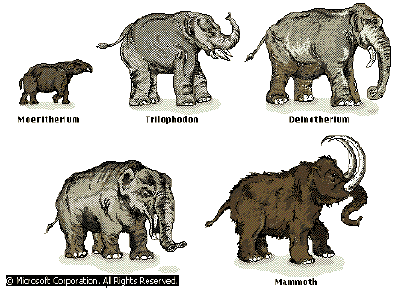
The small, tapir-like Moeritherium, the earliest
member of the proboscidean line, gave rise to a large and widespread
population of which the present-day African and Indian elephants are the
only living representatives. Four-tusked Trilophodon lived from the
Miocene epoch (26 million years ago) to the Pleistocene epoch (2 million
years ago) in Eurasia, Africa, and North America. Also seen in the Miocene
epoch were the downward-curving tusks of Deinotherium. Platybelodon,
with its lowered, flattened, shovel-shaped tusks probably used for scooping
vegetation from the water, occupied Asia and North America in the late
Miocene epoch and the Pliocene epoch (7 million years ago). The largest
proboscidean, the Imperial Mammoth, Mammithera imperater, was well
adapted to the cold in Eurasia, Africa, and North America during the
Pleistocene epoch. Its teeth were much like those of the modern elephant.
© Microsoft Corporation. All Rights Reserved.
|
Web Links
Discovering
Laos: The land of a Million Elephants
Elephant Man, The (1980)
Introduction
to the Proboscidea
The Elephant of the
Africa
The Elephant of the Cameroon
Tusk, Tusk:
Lifting the ban on ivory
Wuchereria
bancrofti: The causative agent of Bancroftian Filariasis
|
[Animals Babies] [Documentary]
[Home] |


